


TSOTSI OPENING
- Oct 6, 2017
- 4 min read

Tsotsi opening
The main protagonist in Tsotsi is Tsotsi. Who is a young South African gangster living in extreme poverty. He controls a small gang of three people; Aap, Butcher, and Buster. When we are first introduced to them they are gambling with dice. We are shown a close up of Butcher’s knife which will soon start Tsotsi’s story.
Immediately, Tsotsi is established as powerful within his group. Through clever choreography of the cinematography, we see him dominate the screen and control his surroundings.
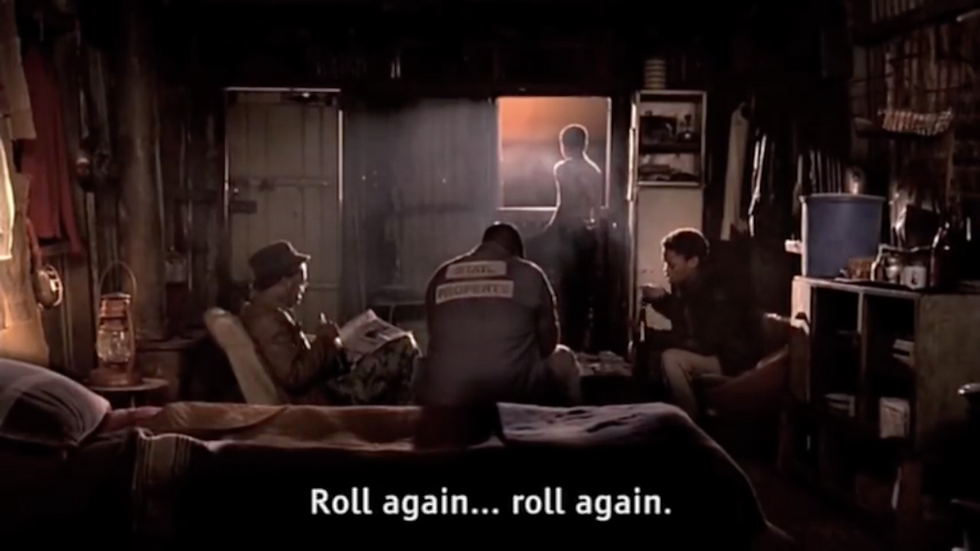
His character positioned according to rule of thirds. This draws the audience’s eye to him. Therefore, even when he is distant and smaller his presence is still stronger than the other characters. This establishes his dominance over the group. He is also not gambling with them, this singles him out as a character who is different and separate from the main cast. Instead he looks out the window with the light shining on him, this foreshadows his characters change and his movement away from crime.
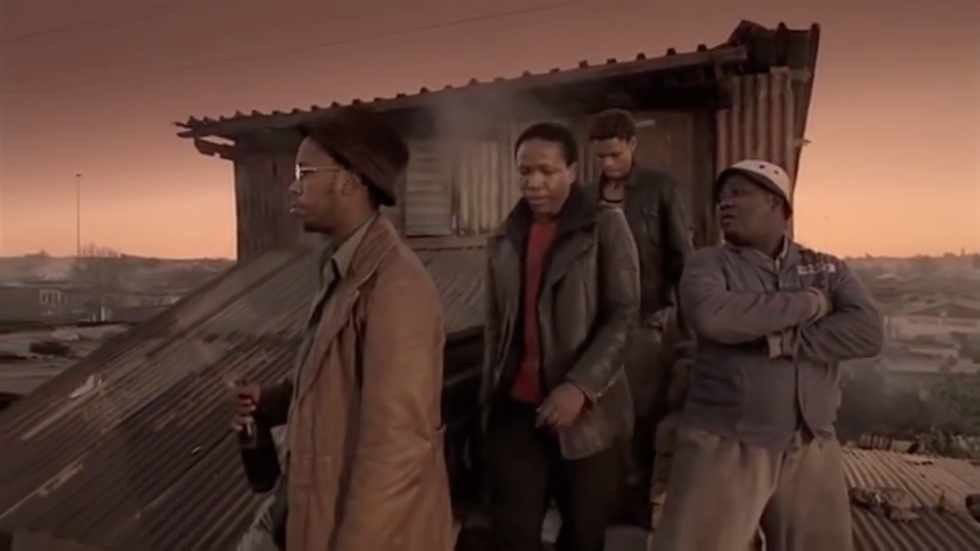
Here is an example of Gavin Hood’s influence from theatre. The characters are very precisely composed, and displayed to the audience as if they were on a stage. Once again Tsotsi is positioned to rule of thirds becoming the main subject of the frame. As he walks towards the camera, he slowly fills more of the frame and seems larger than the rest of his group. When Tsotsi walks past Buster who is currently closest to the screen he barges past him, Buster then follows Tsotsi and steadily becomes smaller and more distant. This is another example of how Hood establishes Tsotsi’s leadership and power.
However, despite being presented as powerful he is not presented as something to be feared. The audience are never victimised by his presence, the camera isn’t ever place below him to make us feel small and as he walks towards the camera he isn’t staring directly at us. Instead the audience are placed eye level, in the position of simply observing, we are not meant to fear his character we are just learning more about him. This is important as later on in the film we need to empathise with him rather than fear.
Next we are introduced to the diegesis, the world is full of poverty, crime and disease.
Hood uses mis en scene and cinematography to emphasise the poor distribution of wealth in South Africa and the environment our protagonist is comfortable in. This is done through comparison of the poorest areas with the richest.

We are shown a crane shot of the town, this emphasises the towns movement and liveliness as we see people moving along the street and smoke wafting into the sky line. However, the land is covered with poorly built infrastructure made of scrap metal. There is a lack of cars with only one parked to the side of the road, and the street is filled with small table market stalls. We learn that it is an undeveloped town, the people here are poor and living conditions are hard. Non diegetic South African rap music plays over the footage which emphasises the idea of gangsters and the towns movement.
It is in this setting that Tsotsi has authority and prominence. He and his group fill the screen and walk in the middle of the street. His red t-shirt stands out against the muddy browns and unsaturated oranges. We can see that it is here that Tsotsi and his group have power, where he is well known to the locals, and controls the path.

However, once he boards the train it’s very different. We learn that the country has a poor distribution of wealth. The scrap metal buildings are replaced with concrete and stable structures.

In the actual train station this is further emphasised. We see the exact same shot type of the village showing a very different setting. The shanty town and tiny markets have been replaced with huge glass and concrete buildings with proper stores. The muddy browns and oranges are gone and instead the screen is filled with crisp and modern whites and blacks. The only colour fitting this scheme in the shot is the muddy yellow advertisement of HIV and AIDS. This comments on South Africa’s ignorance of the poverty and disease it faces. The lonely yellow advertisement stands surrounded in a modern, expensive building. This is very relevant to South Africa’s current condition where 70% of land is owned by white South Africans and only 2.2% earn an income over $50,000 per annum making it one of the most unequally distributed economy in the world. In addition to this 12% of South Africa’s population suffer from HIV and AIDS.
We can see that in this setting Tsotsi becomes the “Nobody” the police refer to him as later on. He no longer fills the screen, he is lost in the crowd barely distinguishable. His red shirt can’t be seen and instead his black coat makes him blend in with the rest of the crowd, he looks like an ant. This has been done to show that in this environment of modernism and wealth Tsotsi is no longer comfortable and powerful. This further emphasises South Africa’s inability to focus on the poverty and crime its country and people suffer with.
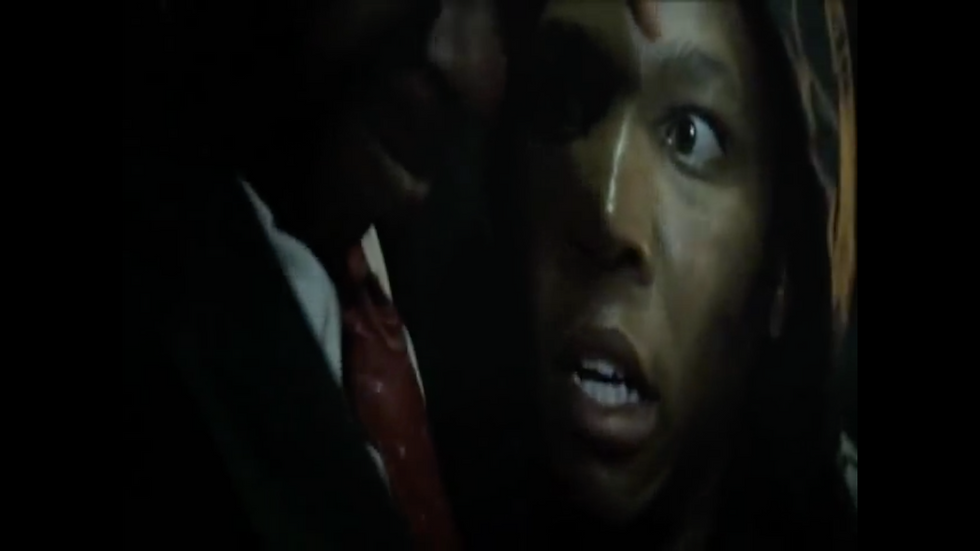

Tsotsi’s character is then presented as empathetic and separate from the rest of his group. We are shown a close up comparison of two facial expressions; Tsotsi and Butchers, when Butcher stabs a man they were mugging the train. We see Tsotsi’s fear and remorse compared to Butchers intimidating seriousness. Tsotsi’s power has been established and yet in the face of murder he loses control. This allows the audience to empathise with him more, we share the shock that Tsotsi does and his character seems more humane and relatable.


Comments